WordPress VIP and Drupal are two strong options for organizations that need a secure, scalable, and flexible content management system.
Both platforms can support government websites, universities, healthcare organizations, large businesses, publishing platforms, and multilingual websites. However, they approach content management differently.
WordPress VIP focuses on providing an easy publishing experience using WordPress, supported by managed enterprise infrastructure and controlled development processes.
Drupal provides a highly flexible open-source framework for building complex websites with structured content, detailed permissions, custom workflows, and advanced integrations.
Neither platform is automatically better for every organization.
The right choice depends on the website’s content structure, editorial team, security requirements, technical complexity, budget, and available developers.
This WordPress VIP vs Drupal comparison explains the important differences in simple language.
WordPress VIP vs Drupal: Quick Comparison
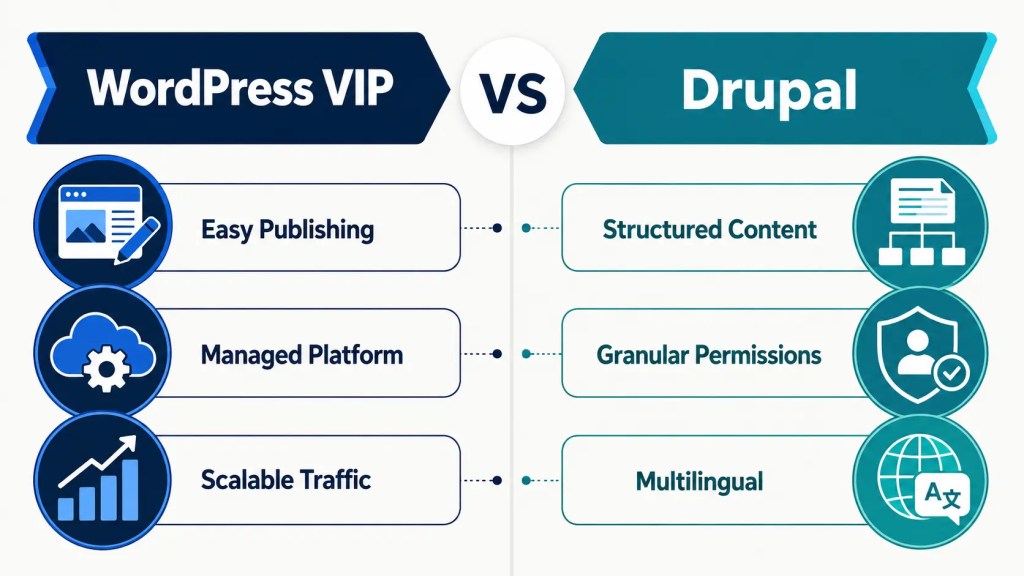
| Area | WordPress VIP | Drupal |
|---|---|---|
| Platform type | Managed enterprise WordPress platform | Open-source CMS and application framework |
| Best suited for | Publishing, media, government, universities and enterprise content platforms | Complex, structured, multilingual and highly customized websites |
| Editor experience | Generally easier for non-technical users | Powerful but may require more training |
| Content modelling | Flexible through post types, taxonomies, fields and blocks | Advanced structured content capabilities in the core platform |
| Development | PHP, WordPress APIs, Gutenberg, JavaScript and React | PHP, Symfony, Twig and Drupal APIs |
| Hosting | Included as part of WordPress VIP | Selected and managed separately unless using Acquia or another managed provider |
| Pricing | Starts at approximately $25,000 per year | Drupal is free, but hosting, development and maintenance are additional |
| Workflow | Available through roles, capabilities and workflow solutions | Content Moderation and Workflows are available in Drupal core |
| Multilingual | Supported through plugins and custom implementation | Strong multilingual capabilities included in Drupal core |
| Multisite | WordPress Multisite or multiple VIP applications | Drupal multisite or separate installations |
| Headless support | REST API, GraphQL options and WordPress APIs | JSON:API, REST and GraphQL options |
| Learning curve | Lower for editors and WordPress developers | Usually higher for editors and developers |
| Maintenance | Much of the platform is managed by WordPress VIP | The organization or hosting provider manages the complete Drupal application |
What Is WordPress VIP?
WordPress VIP is Automattic’s managed enterprise content platform. It uses open-source WordPress but adds managed infrastructure, security controls, performance optimization, monitoring, code analysis, backups, and enterprise support.
Editors continue to use familiar WordPress features such as:
- Gutenberg block editor
- Pages and posts
- Media library
- Revisions
- Scheduling
- Categories and tags
- Reusable patterns
- Custom post types
- User roles
Developers can create custom themes, plugins, blocks, integrations, and headless applications.
Unlike a normal WordPress hosting plan, code changes on WordPress VIP follow a controlled Git-based deployment process. Plugins and themes cannot simply be changed on the production website without following the approved development workflow.
WordPress VIP currently offers annual enterprise plans, with pricing based on factors such as traffic, applications and support requirements. Its enterprise pricing starts at approximately $25,000 per year. WordPress VIP pricing information
What Is Drupal?
Drupal is a free and open-source content management system written in PHP.
It is commonly selected for websites requiring:
- Complex content structures
- Detailed user permissions
- Multilingual content
- Advanced editorial workflows
- Custom integrations
- Large content repositories
- Multiple departments
- Different content relationships
- Strict publishing governance
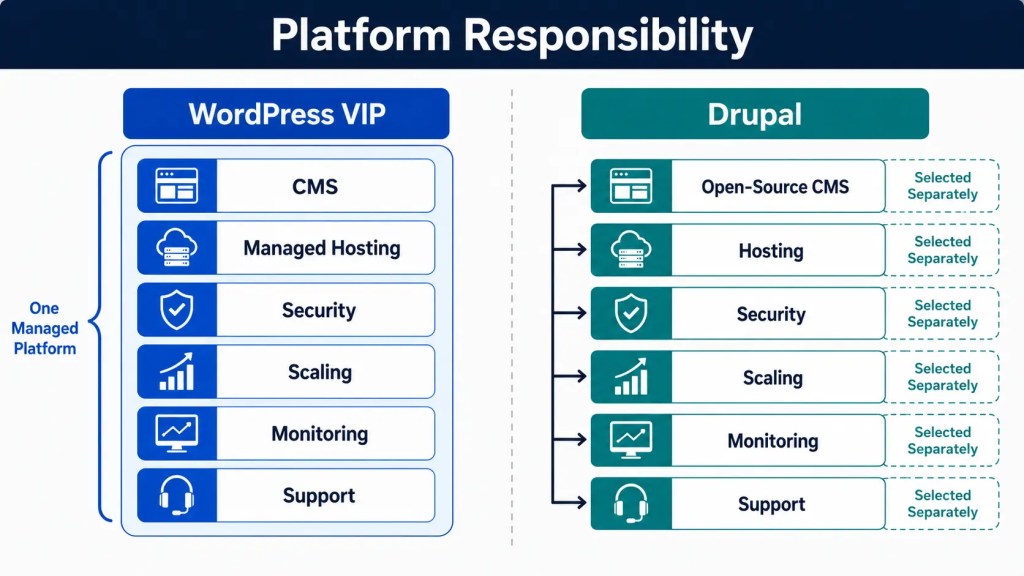
Drupal provides the CMS software, but it does not automatically include enterprise hosting.
An organization can host Drupal on its own infrastructure, use a cloud provider, select a specialized Drupal host, or purchase an enterprise Drupal platform such as Acquia Cloud.
This distinction is important when comparing costs.
WordPress VIP combines the CMS and managed enterprise platform in one service. Drupal is the CMS, while hosting, monitoring, security operations and support depend on the chosen provider.
Acquia Cloud provides managed Drupal infrastructure with development, staging and production environments. Its enterprise pricing is customized according to application size, traffic, storage, features and support requirements. Acquia Cloud Platform overview
Content Editing Experience
WordPress VIP Editor Experience
WordPress VIP generally provides a more familiar and accessible experience for content editors.
The Gutenberg block editor allows users to create pages using components such as:
- Headings
- Images
- Cards
- Columns
- Galleries
- Videos
- Buttons
- Quotes
- Call-to-action sections
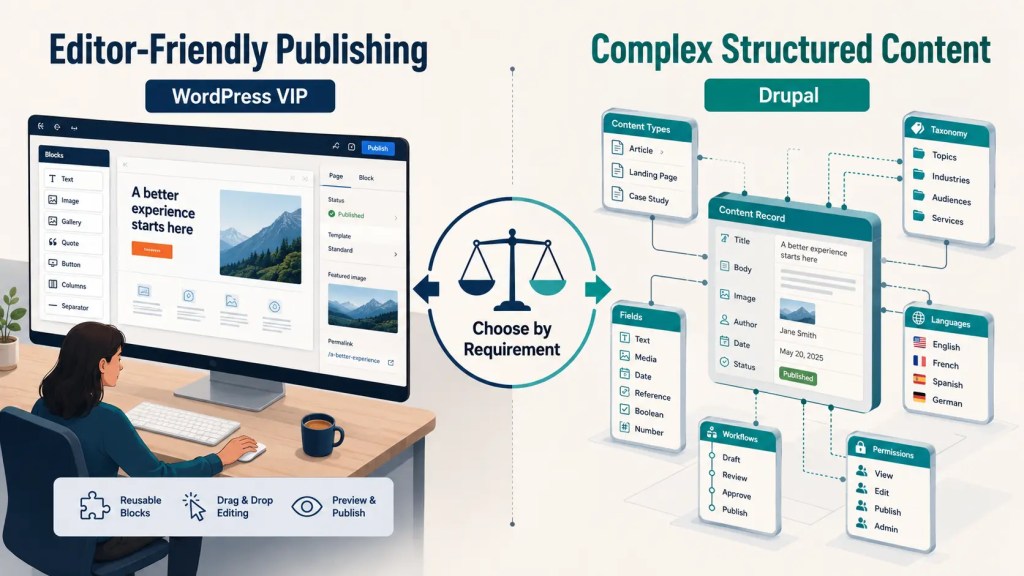
Developers can build approved blocks and patterns that follow the organization’s design system.
For example, a university can provide predefined blocks for academic programs, faculty profiles, news, alerts and course information. Editors only need to update the content without rebuilding the design.
Accessibility and branding rules can also be enforced inside these blocks. This reduces the risk of editors accidentally creating inaccessible or inconsistent layouts.
Drupal Editor Experience
Drupal also provides content editing, media management, layouts, revisions and administrative tools.
Its main strength is structured content.
A Drupal content type can contain precisely defined fields and relationships. For example, an academic program can have separate fields for:
- Program name
- Degree type
- Department
- Campus
- Duration
- Entry requirements
- Application deadline
- Related faculty members
- Related courses
This structure makes content reusable and easier to deliver through APIs.
However, Drupal’s administration interface and terminology may feel more technical to new editors. A well-designed Drupal implementation can be user-friendly, but it often requires more configuration and training.
Winner for general editing: WordPress VIP
Winner for complex structured content: Drupal
Content Modelling and Flexibility
Drupal has traditionally been particularly strong in content modelling.
It provides content types, fields, taxonomies, entities, views and relationships that can be combined to create complex information systems.
This makes Drupal suitable for platforms such as:
- Government service directories
- University course catalogues
- Healthcare information portals
- Product databases
- Membership platforms
- Large multilingual websites
WordPress can also create structured content using custom post types, custom taxonomies, custom fields and Gutenberg blocks.
For many enterprise websites, these capabilities are sufficient. However, developers may need additional plugins or custom development to achieve a content model that Drupal can create using more of its core concepts.
The decision depends on the complexity of the data.
If the website mainly publishes articles, landing pages, resources and standard business content, WordPress VIP is usually easier to operate.
If the website behaves like a complex content database with many relationships, Drupal may offer a more natural foundation.
Editorial Workflows and Permissions
Drupal includes Workflows and Content Moderation capabilities in its core platform.
Organizations can create publishing stages such as:
- Draft
- Department review
- Legal review
- Compliance review
- Approved
- Published
- Archived
Permissions can control which users are allowed to move content between different states.
WordPress includes standard roles such as administrator, editor, author and contributor. More advanced enterprise workflows can be implemented using custom roles, capabilities, plugins and custom development.
WordPress VIP can support complex publishing governance, but the exact workflow must be designed and configured for the organization.
Drupal has an advantage when highly detailed permissions and moderation rules are central requirements. WordPress VIP may still be preferable when the organization wants a simpler workflow that editors can understand quickly.
Multilingual Capabilities
Drupal includes extensive multilingual functionality in its core platform.
It can translate:
- Content
- Configuration
- Administrative interfaces
- Menus
- Taxonomies
- Custom fields
This makes Drupal a strong option for organizations that operate complex multilingual websites.
WordPress supports multilingual websites through plugins, Multisite configurations, separate websites or custom translation integrations.
WordPress VIP can successfully operate large multilingual platforms, but the multilingual architecture must be selected and implemented carefully.
Drupal has the advantage when advanced multilingual content management is required from the beginning.
Security and Compliance
Both platforms can support secure enterprise websites, but security responsibilities are different.
WordPress VIP Security
WordPress VIP manages the underlying platform, infrastructure, WordPress updates, monitoring, vulnerability management and many operational security controls.
Its security portfolio includes FedRAMP Moderate authorization, SOC 2 reporting and infrastructure hosted in ISO 27001-certified data centres. Organizations should still confirm the exact certification scope and contractual requirements during procurement. WordPress VIP security information
WordPress VIP also uses a controlled deployment process, reducing the risk of unauthorized production code changes.
However, the customer remains responsible for:
- Custom code
- User permissions
- Third-party integrations
- Personal data
- Consent management
- Website accessibility
- Application configuration
- Internal security procedures
Drupal Security
Drupal has a dedicated security team and a formal process for reviewing and publishing security advisories.
However, installing Drupal does not automatically create a secure enterprise platform.
The organization must manage:
- Hosting infrastructure
- Drupal core updates
- Module updates
- Server security
- Backups
- Monitoring
- Deployment processes
- Incident response
A managed platform such as Acquia can handle many infrastructure and operational requirements, but its services and costs must be included separately.
The fairest comparison is therefore WordPress VIP versus Drupal running on an enterprise managed platform not WordPress VIP versus the free Drupal software alone.
Performance and Scalability
Both WordPress VIP and Drupal can support high-traffic websites when properly implemented.
WordPress VIP includes managed caching, global content delivery, infrastructure monitoring and scaling as part of its platform.
This makes it particularly attractive to publishers that may experience sudden traffic increases because of breaking news, elections, campaigns or major announcements.
Drupal performance depends more heavily on the selected hosting architecture, caching configuration, modules and custom code.
Managed Drupal providers can offer high availability, content delivery networks and scalable infrastructure. However, these capabilities are not automatically included simply because the website uses Drupal.
Neither CMS can correct poorly written code, unoptimized images, excessive JavaScript or slow external services. Performance still depends on good architecture and development practices.
Plugins, Modules and Development
WordPress extensions are called plugins, while Drupal extensions are called modules.
WordPress has a very large plugin and theme ecosystem. This makes it easier to find developers, integrations and ready-made functionality.
On WordPress VIP, however, a plugin must be compatible with the platform’s security, performance and filesystem requirements. Plugins are deployed through Git and cannot normally be installed directly on production.
Drupal also has a large open-source module ecosystem. Drupal modules can provide functionality such as search, forms, workflows, authentication and integrations.
Both platforms require careful extension selection. A popular plugin or module can still create security, maintenance or performance problems.
The main technical difference is the developer ecosystem:
- WordPress development uses PHP, WordPress APIs, JavaScript, React and Gutenberg.
- Drupal development commonly uses PHP, Symfony components, Twig and Drupal APIs.
WordPress developers are generally easier to find. Experienced Drupal developers are more specialized and may cost more, particularly for complex enterprise implementations.
Headless CMS Capabilities
Both platforms can operate as a headless CMS.
WordPress VIP can deliver content through the WordPress REST API and GraphQL solutions. Drupal provides REST capabilities and JSON:API in its core platform, with GraphQL available through contributed modules.
Either platform can supply content to:
- Next.js websites
- React applications
- Mobile applications
- Digital displays
- Kiosks
- Internal systems
- Partner platforms
Drupal has a strong reputation for structured, API-based content delivery. WordPress VIP provides a simpler editorial experience and can work well when publishing teams are already comfortable with WordPress.
Headless architecture should not be chosen only because it sounds modern. It adds another frontend application, hosting platform, deployment process and maintenance responsibility.
WordPress VIP vs Drupal Pricing
WordPress VIP pricing starts at approximately $25,000 per year. The final price depends on traffic, applications, support and other enterprise requirements.
Drupal is free to download because it is open-source software. However, a production Drupal website is not free to build or operate.
Drupal costs can include:
- Enterprise hosting
- Design and development
- Drupal specialists
- Module development
- Security updates
- Version upgrades
- Monitoring
- Backups
- CDN and web application firewall
- Technical support
- Ongoing maintenance
Acquia and other enterprise Drupal providers generally use custom pricing for large implementations.
Therefore, comparing a $25,000 WordPress VIP subscription with Drupal’s zero licence fee would be misleading.
Organizations should compare the complete cost of ownership, including hosting, development, support, upgrades, security and internal staffing.
Which CMS Is Easier to Maintain?
WordPress VIP generally requires less infrastructure management because the platform manages much of the hosting, scaling, monitoring and WordPress runtime.
Development teams still manage themes, plugins, integrations and custom code, but they do not need to build the entire enterprise hosting platform themselves.
Drupal maintenance depends on the hosting model.
A self-managed Drupal installation gives an organization greater infrastructure control, but it also creates more operational responsibility. A managed Drupal service reduces that responsibility at an additional cost.
Drupal upgrades can also require careful planning when modules, themes or custom code are affected by platform changes.
For organizations wanting a more standardized managed environment, WordPress VIP may be easier to operate.
Migrating from Drupal to WordPress VIP
Drupal-to-WordPress VIP migration is possible, but it should not be treated as a simple database transfer.
A proper migration includes:
- Auditing Drupal content types, fields, taxonomies and relationships.
- Mapping Drupal content to WordPress post types, taxonomies, fields and blocks.
- Rebuilding templates as Gutenberg blocks and patterns.
- Reviewing users, roles and editorial workflows.
- Replacing Drupal modules with WordPress plugins or custom functionality.
- Migrating documents, images and alternative text.
- Preserving URLs and creating redirects.
- Validating metadata, canonical tags and structured data.
- Testing accessibility, search, integrations and performance.
- Completing a final content migration before launch.
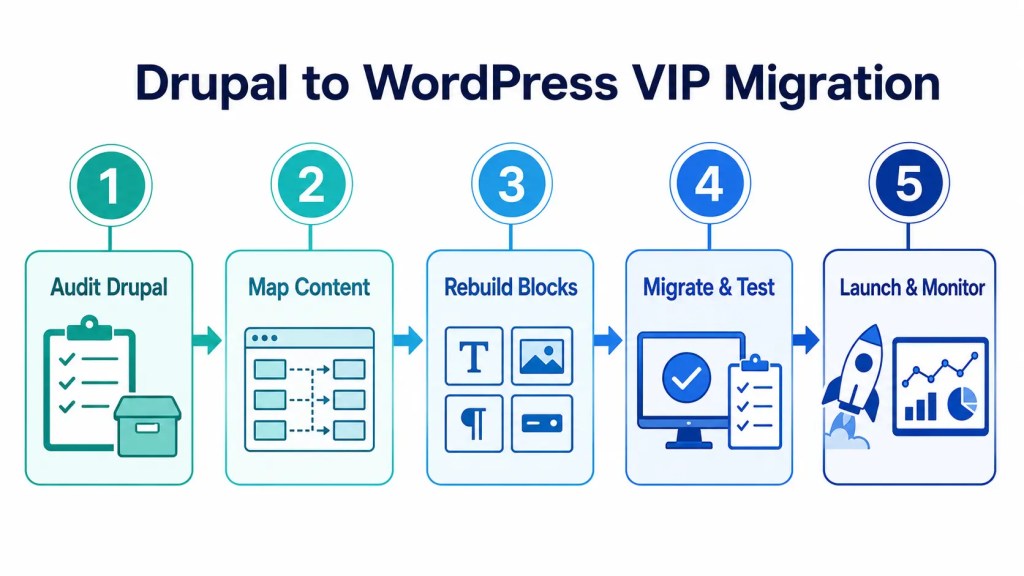
Complex Drupal content relationships may require custom migration scripts. Layout Builder or Paragraphs content should normally be transformed into clean Gutenberg blocks instead of being copied as unstructured HTML.
The migration is often worthwhile when the organization wants to simplify editing, reduce Drupal specialization requirements or consolidate websites onto an enterprise WordPress platform.
When Should You Choose WordPress VIP?
WordPress VIP may be the better choice when:
- Editors need a simple and familiar interface.
- Publishing speed is a major priority.
- The website contains news, articles, resources and landing pages.
- The organization expects unpredictable traffic.
- Managed infrastructure is preferred.
- Git-based and auditable deployments are required.
- WordPress skills are already available internally.
- Multiple websites need shared blocks and design patterns.
- The organization wants to reduce infrastructure management.
When Should You Choose Drupal?
Drupal may be the better choice when:
- Content has many complex fields and relationships.
- Advanced multilingual management is a core requirement.
- Permissions must be extremely detailed.
- The website operates more like an information system than a publishing website.
- Drupal expertise is already available.
- The organization requires complete control over hosting and architecture.
- Complex workflows are required using core Drupal capabilities.
- Existing Drupal integrations would be expensive to rebuild.
Final Verdict
WordPress VIP and Drupal are both capable enterprise content management systems, but they solve different problems particularly well.
WordPress VIP is generally better for organizations that prioritize editor usability, rapid publishing, managed infrastructure, enterprise support and access to a larger developer ecosystem.
Drupal is generally better for organizations that require highly structured content, complex relationships, advanced multilingual features and detailed permissions.
For a large content-driven website, WordPress VIP may provide a better balance between enterprise control and ease of use.
For a complex platform with deeply connected data and specialized workflows, Drupal may remain the stronger technical choice.
The final decision should be based on real requirements rather than CMS popularity. Organizations should compare content structure, workflows, integrations, security, hosting, developer availability, migration effort and total cost of ownership before selecting either platform.
Frequently Asked Questions
WordPress VIP is usually easier for editors and includes managed enterprise infrastructure. Drupal may be better for highly structured content, detailed permissions and complex multilingual websites. The better option depends on the project requirements.
Both can be secure when implemented correctly. WordPress VIP includes managed platform-level security, while Drupal security depends more heavily on the chosen hosting provider, modules, updates and operational practices.
WordPress VIP pricing starts at approximately $25,000 per year. The final cost depends on traffic, applications, support and enterprise service requirements.
Drupal is free and open-source software. Organizations must still pay for hosting, development, maintenance, security, upgrades and technical support.
Yes. WordPress VIP can support government websites and currently holds FedRAMP Moderate authorization. Each organization must still verify whether the platform and proposed implementation satisfy its particular procurement and compliance requirements.
WordPress VIP is generally easier for non-technical editors because Gutenberg offers a more visual and familiar publishing experience. Drupal can also be user-friendly, but it may require additional configuration and training.
Drupal has stronger multilingual features in its core platform. WordPress VIP can support multilingual websites, but it normally requires plugins, Multisite, separate applications or a translation integration.
Yes. Content, users, taxonomies, media and metadata can be migrated. Complex fields, relationships, layouts, workflows and integrations may require custom mapping and development.
Yes. Both platforms can deliver content to Next.js, React, mobile applications and other channels through APIs.
No. Drupal is the open-source CMS. Acquia is a commercial company that provides managed Drupal hosting, development tools, security services and other digital-experience products.
WordPress VIP may have lower development and training costs when the project mainly involves publishing and standard enterprise content. Drupal may cost more when specialist developers and complex customization are required. Actual costs depend on the website’s architecture and features.
Both can work well. WordPress VIP is attractive when departments need an easy publishing experience and shared design components. Drupal may be preferable when programmes, courses, faculty, departments and research content require complex relationships and multilingual management.